Unlocking Procrastination's Real Code
3-Questions to Targeted Fixes

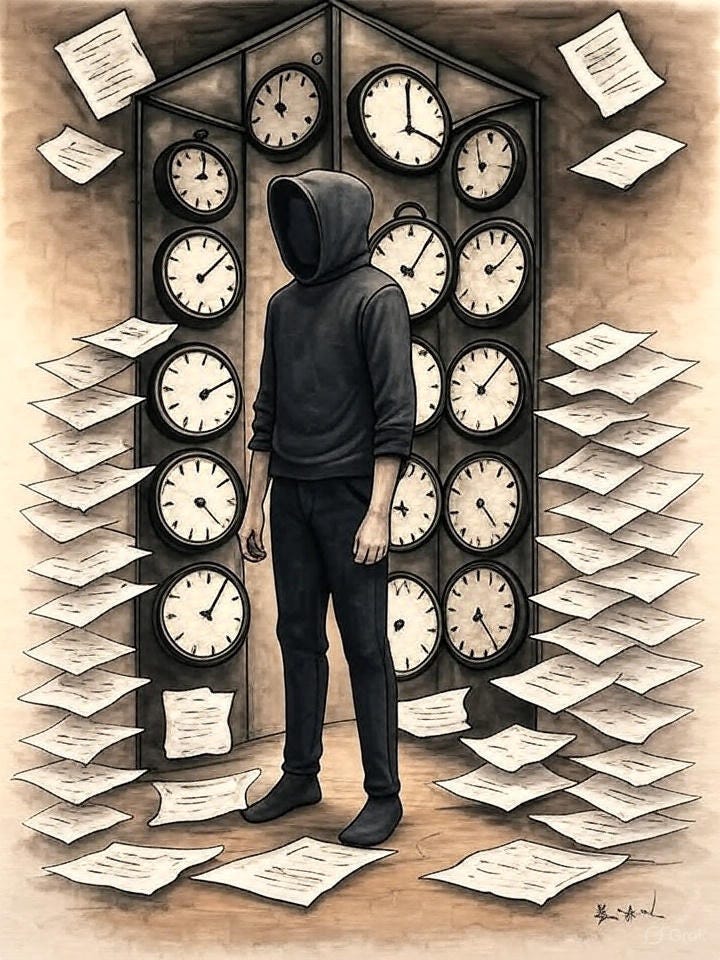
You finally have freedom.
No more boss, no more imposed schedules. Just an infinite horizon of possibilities.
And yet, you are paralyzed.
Instead of conquering the world, you reorganize your folders for the tenth time. You spend hours polishing a logo instead of making that crucial call. Freedom, which was supposed to be your greatest ally, has become an invisible cage.
Your procrastination is not laziness—it’s either boredom sabotaging you or anxiety paralyzing you.
Stop fighting the wrong battle.
The Great Lie of Willpower
You have two brains. The first, rational, plans. The second, your survival brain, screams for a dose of dopamine now.
Procrastination is when your survival brain wins.
The biggest misunderstanding is believing it’s a discipline problem. It’s a lie. A story we tell ourselves to feed guilt.
As researcher Dr. Piers Steel says, it’s a failure of emotional regulation.
You can’t win an emotional war with a logical weapon. Your to-do list is a pocket knife in a shootout.
Let’s dismantle the myths keeping you prisoner:
Myth 1: It’s laziness. No. Laziness is an aversion to effort. You overflow with energy... which you invest in substitute activities to escape an unpleasant emotion.
Myth 2: I work better under pressure. It’s a rationalization. The work gets done, rarely better. Quality comes from reflection, not panic. It’s a strategy that leads to burnout.
Myth 3: You have to wait for inspiration. An illusion. “Flow” is a consequence of action, not its condition. Action precedes motivation. Always.
Myth 4: It’s a failure of logic. (For the Pro) You know everything. You’ve tried every method—GTD, Bullet Journal... You’re a pro... and yet, you still pro-crastinate sometimes... hmm .😢.. These methods suggest clarity is enough for action. Well, necessary, yes... but not enough... because they ignore the fundamental reality: we don’t flee the task, we flee the emotion the task triggers. Logic is not enough, Mr. Spock 🖖..
The real problem is the “Intention-Action Gap.” You know what you need to do. But you don’t do it. It’s not a moral failing. It’s a failure of self-regulation in the face of discomfort.
The Two Faces of Your Inner Enemy
Your procrastination changes faces depending on the terrain.
Under constraint, in the corporate world, it’s an escape from boredom 🥱. The path is marked, tasks defined. Procrastination becomes a silent rebellion: “busy work,” perfectionism, waiting for adrenaline to finally feel something.
In freedom, for the solopreneur, it becomes paralysis in the face of anxiety 🫨. It’s the paradox of freedom. Without external structure, uncertainty is maximal. You no longer flee the task, but the vertigo of having to draw your own map in a world without paths. You flee through dispersion, over-planning.
The manager has a foot in both camps. He handles routines under constraint, but the day he has to launch a strategic initiative, it’s a blank page. He shifts into the anxiety of freedom.
Understanding which face you’re facing is the first step to regaining control.
The 3-Question Diagnosis
So, Anxiety 🫨. ? Or Boredom 🥱?
Stop guessing. Diagnose your procrastination in 60 seconds with these three questions.
1. What is the nature of your task? (Creation vs. Execution)
Execution? The path is clear, predictable. If you procrastinate here, it’s probably boredom.
Creation? The path is fuzzy, uncertain. If you procrastinate here, it’s probably anxiety.
2. What is your dominant emotion? (Frustration vs. Fear)
Frustration? An irritation, impatience. “I don’t feel like it.” It’s the signal of boredom.
Fear? A knot in the stomach, tension. “What if I don’t succeed?” It’s the signal of anxiety.
3. What is your escape behavior? (Distraction vs. Dispersion)
Distraction? You flee a low-stimulation task for a high-stimulation one (social media, videos). It’s the behavior of boredom.
Dispersion? You flee an anxiety-inducing task for another productive but less intimidating one (reorganizing folders instead of prospecting). It’s the behavior of anxiety.
The grid is simple:
Execution + Frustration + Distraction = Boredom.
Creation + Fear + Dispersion = Anxiety.
Take Alex, a freelancer who has to prospect.
Creation task.
Fear emotion.
Dispersion behavior.
The diagnosis is clear: Anxiety.
Alex isn’t lazy. He’s paralyzed by uncertainty.
Tailored Weapons for the Right War
Stop using a hammer to screw in a screw.
If it’s boredom, inject challenge.
Gamify the task: Use the Pomodoro technique. The goal is no longer “finish the accounting,” but “do one Pomodoro.” It’s a short, measurable challenge.
Change context: Work in a café. Use a new tool. Novelty breaks monotony.
Stack habits: Pair the boring task with a reward. “I can listen to my favorite podcast only while doing the dishes.”
If it’s anxiety, create clarity.
Reduce the task to the absurd: The 2-Minute Rule. “Write an article” becomes “Open a document and write one sentence.” The goal isn’t to finish, but to start.
Define “Done”: Perfectionism is a form of anxiety. Set the finish line before starting. “The task will be ‘done’ when the first draft is written, regardless of quality.”
Create quick feedback loops: Do a “Spike.” A short experiment (45 min) whose sole purpose is to reduce uncertainty. The deliverable isn’t a product, but a decision.
Become the Architect of Your Freedom
Stop trying to “defeat” your procrastination.
It’s a signal, not an enemy.
It tells you the truth: either this task is deeply boring, or it paralyzes you with fear. Listen to it, and you’ll finally know the real problem to solve.
This is where you shift from victim posture to that of the architect. The architect of your environment, your focus, and ultimately, your freedom.
Intimidating tasks become manageable challenges. You’re no longer reacting; you act with intention.
It’s the passage from a suffered life to a chosen life.
Key Takeaways:
Emotional root, not logical: Procrastination is a failure of emotional regulation. Myths of laziness or inspiration only feed guilt. Diagnose the real cause: boredom or anxiety.
Targeted strategies, not generic: Against boredom, inject challenge (Pomodoro, gamification). Against anxiety, create clarity (2-Minute Rule, quick feedback). Adapt your weapons to the right battle.
Signal, not enemy: See procrastination as an ally that informs you. Listen to it to shift from victim to architect of your environment and freedom.
Try it now! (or procrastinate it ;-). Take 5 minutes. Pick one task you’re avoiding right now. Diagnose it with the 3 questions. Apply the targeted strategy. Is your trigger clear now? Boredom or Anxiety?
Share your insight in the comments (or procrastinate the feedback, why not? (Cheeky!)
If this resonated with you, restack to amplify the conversation!